

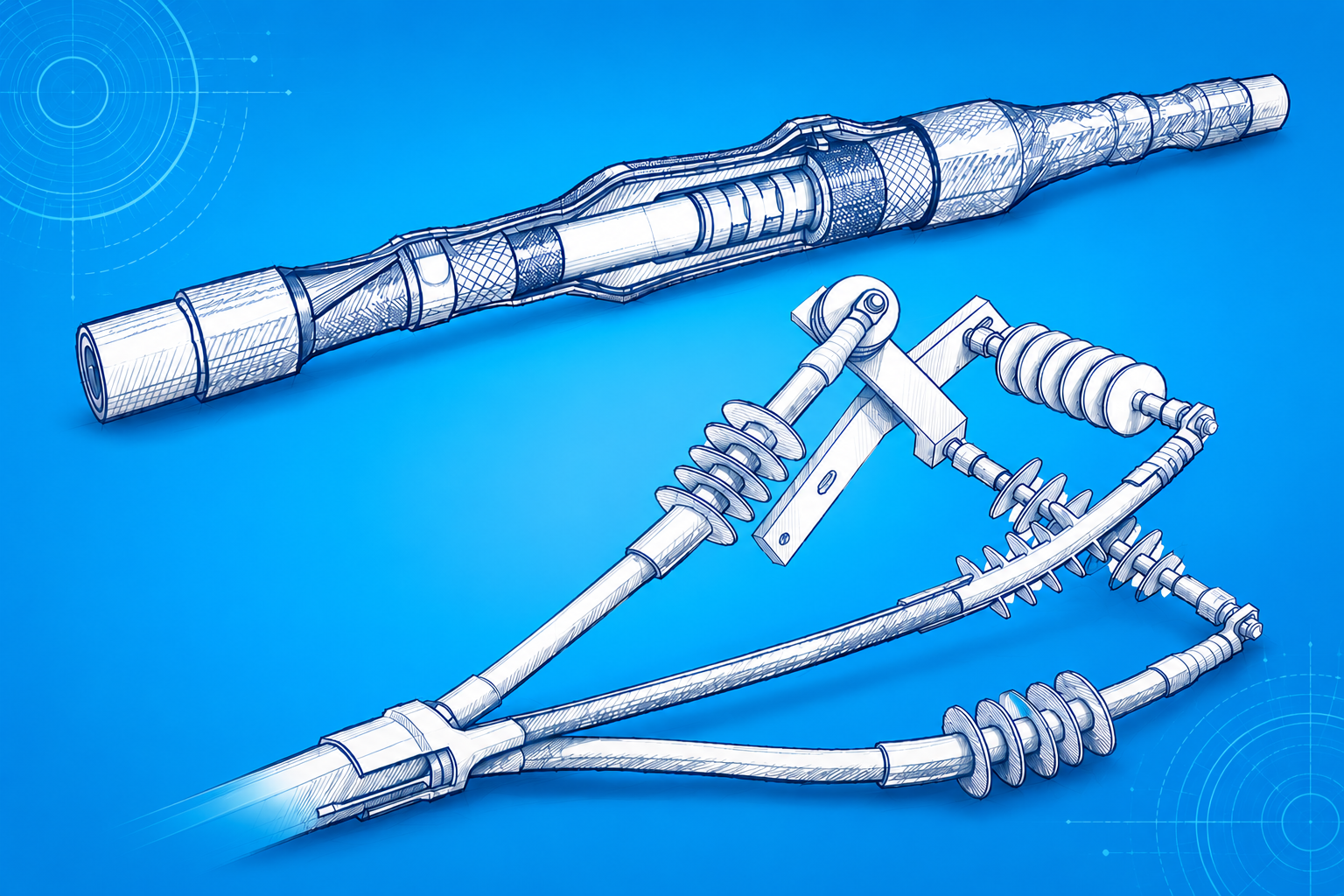
Reliable power distribution across the GCC depends on cable accessories that can perform under demanding operating conditions. From utility networks and industrial plants to oil & gas facilities and infrastructure developments, projects across the region rely on cable joints and terminations that deliver long-term electrical operation.
Engineers working in the UAE, Saudi Arabia, Oman, Kuwait, and Bahrain face common challenges, including high temperatures, dust, humidity, thermal cycling, and extensive underground cable networks. Choosing the right Medium Voltage Cable Accessories helps maintain network performance while reducing maintenance and unplanned outages.
Cable accessories installed across the GCC operate in demanding environments that differ from many other regions. High ambient temperatures can accelerate insulation ageing, airborne dust may affect sealing during installation, and coastal humidity increases the need for effective moisture protection. Daily thermal cycling causes repeated expansion and contraction of cable systems, while long underground cable routes demand joints and terminations that continue performing reliably for many years. These conditions explain why utilities, consultants, and EPC contractors place such importance on proven cable accessory systems.
Because many power networks across the region rely on underground cable installations, effective sealing at cable joints and terminations becomes especially important to prevent moisture ingress and maintain long-term electrical integrity.
People outside the industry sometimes assume that cable accessories are secondary components. In reality, they are often the locations where networks face their greatest challenges.
Consider a typical underground distribution project. A cable route may extend across several kilometres, passing through roads, buildings, utility corridors, and substations. Along that route, cables may need to be joined together multiple times. Every joint must restore the cable's insulation system, maintain current-carrying capacity, and keep moisture away from critical components.
The same applies to cable terminations. Whenever a cable connects to a transformer, switchgear panel, or motor control centre, the electrical stress at the cable end must be carefully managed. If it isn't, insulation breakdown can begin long before anyone notices a problem.
This is why utility engineers rarely look at cable joints and cable terminations as simple accessories. They see them as critical parts of the network that can influence the reliability of the entire system.
An 11kV Cable Joint installed beneath a busy road or a 33kV Cable Termination inside a utility substation may remain out of sight for decades. The expectation is simple. It should continue performing without creating maintenance concerns, operational interruptions, or safety risks.
Utility approvals involve far more than meeting procurement requirements. Before cable accessories are approved for use, they undergo technical evaluations covering electrical, thermal, mechanical, and environmental performance. These assessments help verify that products can perform reliably under the demanding conditions found across GCC power networks.
While UAE utilities such as DEWA, TAQA, FEWA, Etihad WE, and SEWA have specific approval requirements, projects throughout Saudi Arabia, Oman, Kuwait, Bahrain, and the wider GCC follow similar technical expectations. Engineers and consultants specify approved products because long-term reliability is often more important than the initial purchase cost.
Large GCC infrastructure projects often require multiple cable accessory technologies within the same network. Heat shrink joints, pre-moulded terminations, separable connectors, and transition joints may all be specified on a single project. Working with one manufacturer helps simplify procurement and maintain installation consistency.
Al Yamuna Densons manufactures a wide range of Medium Voltage Cable Accessories, including:
Having access to a complete range simplifies procurement and helps ensure consistency across the installation.
Ask ten engineers which cable accessory technology they prefer and you'll probably get several different answers.
Heat shrink technology remains popular because it has a long history within utility and industrial projects. Installation teams are familiar with it, utilities trust it, and its performance has been proven across countless installations.
Cold shrink technology gained popularity because it simplifies installation. Since the insulation is already expanded during manufacturing, installers don't need an external heat source. This can be particularly useful on projects where speed, safety, or installation consistency are priorities.
Pre-moulded systems have become increasingly common in applications where dimensional consistency and electrical performance are especially important. Utilities often specify these products for critical installations because much of the manufacturing precision is built into the product before it reaches the site.
The interesting thing is that no technology has completely replaced the others. Each continues to serve a specific purpose, which is why engineers evaluate project requirements carefully before making a final selection.
Most failures can be traced to installation quality rather than the product itself. Moisture ingress, contamination, incorrect connector crimping, insulation damage during cable preparation, and partial discharge remain the most common causes of premature failure. Small installation defects may remain unnoticed for years before developing into network faults, making proper installation just as important as product quality.
Utility approvals place significant emphasis on testing because product performance must be verified before installation on critical power networks. Cable accessories are typically evaluated through partial discharge, AC voltage withstand, lightning impulse, heat cycle, and short-circuit testing to assess their electrical, thermal, and mechanical strength. Products designed in accordance with recognised international standards, such as IEC 60502 and IEC 60840 provide consultants and project owners with greater confidence during specification and procurement.
Medium Voltage Cable Accessories are widely used across utility networks, oil & gas facilities, petrochemical plants, renewable energy projects, airports, railways, industrial plants, commercial developments, and data centres thro
ughout the GCC. In these environments, dependable cable joints and terminations help minimise downtime, improve safety, and support continuous power distribution.
Al Yamuna Densons brings more than 50 years of cable accessory manufacturing expertise, backed by a proven track record across GCC utility, infrastructure, industrial, and oil & gas projects. Our heat shrinkable cable accessories have been successfully supplied across GCC markets for over 25 years, while our pre-moulded cable accessory solutions have supported regional projects for more than 10 years. Combined with regional engineering support and products manufactured to international quality standards, we help contractors, consultants, utilities, and EPC companies from product selection through installation.
Whether you're specifying cable accessories for an 11kV distribution network, a 33kV substation, an industrial expansion, or an oil & gas facility, our engineering team can help you select the right solution. Request technical datasheets, product recommendations, utility approval guidance, or application support for your next GCC project.
Have a question, idea, or requirement? Drop us a message and our team will get back to you with clear answers no fluff, no delay.